How Can You Be Angry? You’re a Buddhist!

This entry was written by Dolma, an Angry Asian Buddhist who works for an interfaith organization.

In an interview with Time Magazine, His Holiness the Dalai Lama was asked, “Do you ever feel angry or outraged?” His Holiness laughed as he replied, “Oh, yes, of course. I’m a human being. Generally speaking, if a human being never shows anger, then I think something’s wrong. He’s not right in the brain.” While I enjoyed His Holiness’ initially confused expression, I also appreciated his answer. Because really, it’s a silly question, especially when you consider the obstacles and difficulties that His Holiness has faced throughout his life. However, many Buddhists are asked this same question. I’m often asked, “Do you get angry?” or worse, “How can you be angry? You’re a Buddhist.”

From the looks of shock I receive, it seems like I’m confessing to some debilitating habit or addiction. But it’s simply my truth, one aspect of my humble experience. I’m an angry, South Asian, Buddhist woman. And sometimes, it isn’t easy being an angry Buddhist. It isn’t easy when someone trivialises your ability and need to be angry.

Of course any unexpected reaction is bound to be surprising. But it’s the dismissal of anger that’s insulting. The, “you’re overreacting” or “Buddhists aren’t supposed to get angry.” While it’s definitely true that the Dharma encourages us to acknowledge and then release our anger, I don’t understand the high expectations many have of Buddhists. It’s ridiculous to assume that Buddhists have a monopoly on kindness. And at the same time, does any religion promote anger? Or does any religion suggest that one should never be angry? If a Christian expressed his/her anger at the commercialisation of Christmas, I doubt a common reaction would be, “How can you be angry? That isn’t very Christ-like.” Or if a Muslim expressed frustration with Islamophobia, would anyone say, “Well, the Holy Quran states, ‘Those who spend in Allah’s Cause, in prosperity and in adversity, who repress anger, and who pardon men; verily, Allah loves.’” But many individuals, whether they have any knowledge of Buddhism or not, seem to be comfortable with hushing a Buddhist critique. A patronising “calm down,” some poorly recited Sutras, and a “Well, I’ve read Siddhartha.” That’s what we get. Fantastic.

These dismissals truly stem from Orientalist ideologies. Asians are perceived as submissive and obedient, and therefore, adherents to an Asian religion must contain themselves in a similar manner. This is where my anger truly stems from, which is why I feel disheartened when my fellow Buddhists suggest that I’m overreacting. I always welcome discussion on religion, theology and spirituality. However these situations are not respectful engagements, they’re the layering of weary prejudices that are inherently violent. They’re disrespectful to my religion, ethnic community, and to my identity as a whole. In his teachings on anger, the Buddha encouraged us to avoid harmful speech, and to apply lovingkindness where there is anger. He also said, “Speak the truth, control anger.” So, how can I get angry if I’m a Buddhist? It’s very simple. I’m a human being, I get angry sometimes. I just don’t let my anger consume me; instead, I speak my truth.

Happy Lunar New Year!

It’s that time of year again.

With no response to my feeble request for a holiday interview, I decided to answer the usual interview questions myself.

Who are you?

I’m an Asian American Buddhist blogger. I blog on Dharma Folk and the Angry Asian Buddhist blogs. As of the past few months, you’re likely to find more frequent updates on Twitter.

What’s the Buddhist significance of this holiday?

For most of my life I haven’t thought of this holiday as having any intrinsic connection to Buddhism. I’ve always seen it as a holiday derived from Chinese culture that’s been infused with some Buddhist practices. But the same could be said of a lot of other “Buddhist” holidays like Rohatsu, which at root is a Chinese harvest festivalthat’s evolved into something that most Western Buddhist bloggers would only recognize as a winter Zen retreat.

If there’s anything very “Buddhist” about this day, I’d say it’s an opportunity to start the year with some good “Buddhist” deeds, so that these deeds will hopefully trickle forward into positive habits throughout the year. I usually begin with a midnight vegetarian meal and later visit temple with family or friends.

That said, I just read on Rev. Heng Sure’s blog that this day has another Buddhist connection of which I’d never known: “For practicing Buddhists the first day of the lunar new year is the celebration of Maitreya Bodhisattva’s anniversary. Maitreya is famous for having subdued his temper through learning ‘patience under insult.’ You simply can’t upset him. Insults, curses, even blows will not get his goat or shake his equanimity. He has a big belly, not from greed for food but from holding all the chi (qi) that people have thrown at him. Swear at him, cut him off in traffic, insult his mother, he endures it all because he has subdued himself—his false pride and vanity are long gone. He sees through the surface of relationships and understands that you wouldn’t be giving him grief if you had peace of mind. Why increase your afflictions by getting caught up in your unresolved drama? It has nothing to do with him, and he won’t waste a second of precious lifetime struggling with hurt feelings or animosity.”

What does this holiday mean to you?

For me, the New Year is all about home, family, and community. Friends have been sending me Chinese New Year videos that remind me to appreciate my parents, to never underestimate the power of love, and to never leave home behind. I haven’t eaten a New Year dinner with my family in well over ten years, but I hope to change that starting next year.

What do you plan to do for the Lunar New Year?

I’ve already done the temple visits. On the Saturday before New Year, some friends invited me to visit Hsi Lai Temple. I hadn’t visited the temple in five years, so it was refreshing to walk around, partake in delicious vegetarian food, and observe some New Year rituals before the crush of visitors expected yesterday and today.

As I’m writing this post late at night on Lunar New Year’s eve, I’m probably going to have a small vegetarian snack at midnight before preparing for tomorrow. My New Year’s plan is to send good wishes to my family and friends, to practice sitting meditation in the morning and evening, and to reflect and plan on what I’d like to do differently this year compared to last year.

There are a couple other Lunar-ish New Years coming up, so stay tuned.

And Happy New Year!

Buddhist Holidays 2012

I am going to try to continue last year’s experiment and interview people about how they celebrate Buddhist holidays. Many holidays went without interviews last year; I’m hoping this year will be more productive.

  • Lunar New Year · January 23
  • Losar · February 22
  • Magha Puja · March 7
  • Hanamatsuri · April 8
  • Songkran · April 13–15
  • Gotan-e · May 20–21
  • Vesak · June 4
  • Obon · July & August
  • Asalha Puja · August 2
  • Vu Lan · August 31
  • Ohigan · September 22
  • Kathina · November
  • Rohatsu · December 8

This list is by no means an exhaustive catalogue of Buddhist holidays. It’s more of a map (and reminder) for future holiday posts. You can find another partial list at About.com’s Buddhism page. If there are other Buddhist festivals you’d like for me to cover, just drop a note below in the comments (links would be useful too), and I will consider them.

Corrections are also most welcome.

Why is American Buddhism so White?

Shambhala Sun Foundation Staff

The provocative title of this post comes not from one of my sleep deprivation induced paroxysms of self-righteous indignation, but rather from a beautifully selected forum discussion in the current issue of Buddhadharma: The Practitioner’s Quarterly.

You can read the forward by Charles Johnson online, but you’ll have to buy a copy of Buddhadharma to read the entire discussion with Larry Yang, Amanda Rivera, angel Kyodo Williams and Bob Agoglia. You’ll also find a great piece by Jan Willis, “Yes, We’re Buddhists Too!” I couldn’t recommend this issue enough.

The forum discussion is one that readers of this blog really shouldn’t ingore. Read it and let me know: what did you think?

Support Lao Buddhists of Colorado

There is a huge backlog of Angry Asian Buddhist posts that I haven’t quite gotten around to, but some issues are more important than others. This is one of them. Gil Asakawa writes from Colorado:

The Laotians epitomize the ability of recent immigrant communities to hang together and promote their traditional culture and values while they (especially the younger generation) embrace American culture and values. That sense of unity will serve them well in the months to come, as they rebuild “their heart and soul,” as one tearful women described the temple.

[…]

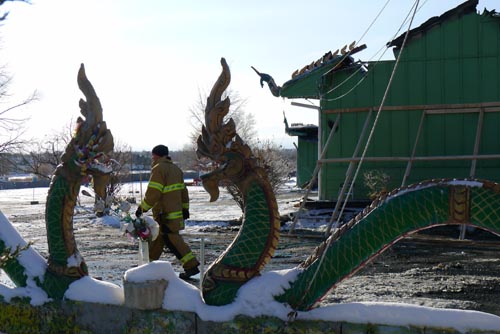
I visited the temple yesterday afternoon and felt an indescribable sadness for their loss. Firefighters were still milling about, sifting through debris, probably investigating the cause of the fire. Police blocked the street (the temple faces a side street, not Wadsworth Blvd., which is a major thoroughfare). But a steady stream of Laotians kept coming by, parking their cars down the block and walking to the temple to pay their respects and offering their help.

One young man sitting in his car with his baseball cap askew rolled down the window and turned down the hip-hop on stereo to ask me details about the fire. I told him what I knew. He told me he’d helped the head monk for several years and considered him a mentor. A woman who parked her car and began walking began sobbing when she got her first look at the burned-out skeleton of the temple. She said she left work early when she first heard about the fire. Many of the visitors had just heard about the tragedy through the community grapevine while at work.

The community has established the Lao Buddhist Temple Fire Relief Fund at 1stBank, a Colorado-based bank chain, and is accepting donations to help rebuild the temple. You can find the nearest 1stBank location here, or call Sy Pong at 720-210-7555 or Maly at 720-217-6142.

It’ll help the Laotians bring back to life the heart—and soul—of their community.

Please support Colorado’s Lao Buddhists. You can learn more about the situation at the links below.

  • Congregation gathers at Buddhist temple lost in Westminster fire [Nina Sparano, KWGN]
  • Community rallies to rebuild Buddhist temple destroyed by fire in Colorado [Buddhist News]
  • Lao Buddhist Temple of Colorado Needs Help to Rebuild After Devastating Fire [Gil Asakawa, Huffington Post]
  • Buddhist Monks Hoping To Recover Temple Artifacts After Fire [Deb Stanley, ABC7News]
  • Blaze destroys Buddhist temple [CNN]

If you donate more than $250, I’ll send you a thank you card. More importantly, you’ll be providing enormous help to a Buddhist community that dearly needs it.

Update: In response to a question on Twitter, the fire occurred in Westminster, a suburb northwest of Denver. You can also get more information about donations at the temple’s website: laobuddhisttempleofcolorado.com.

The White Face of Buddhism Now at Patheos

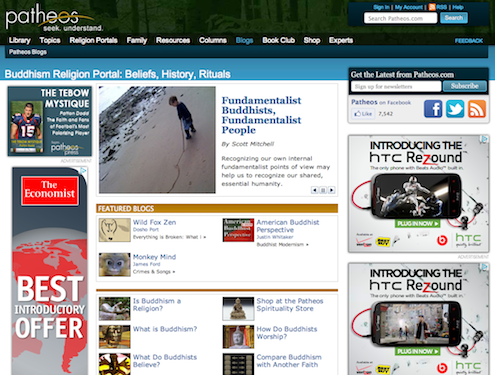
Danny Fisher just announced that he’ll be maintaining a new Patheos blog, which was mention enough to spark my smoldering curiosity and get me to check out the Patheos Buddhism Portal. So I visited and saw a landing page covered with the work of White people.

I really worked hard to find the Buddhist Asian folk, but Patheos seems to have created an almost perfect showcase for the stereotype online Buddhist: the White Buddhist American man.

Well okay, I managed to sniff out some diversity in that collection of essayson the “Future of Buddhism” in the United States. Among those 22 essays, you can find four written by Asian authors—namely Mushim Ikeda-NashVenerable Sheng YenChade-Meng Tan and George Tanabe. With about 18% of those essays by Asians, this Patheos collection ranks at about the same level of Asianness as the general Western Buddhist publication—perhaps a noteworthy trend?

Yes I know that Justin Whitaker has publicly vowed to make the effort to try to be “more representative of American/Western Buddhism.” He even followed through by posting about an African American Buddhist! I can’t wait till he writes about another Person of Color!

So at least you know that the Patheos Buddhism Portal isn’t the exclusive preserve of White Buddhists. The Portal is not all White—it’s just overwhelmingly dominated by White American Buddhists. And that’s a problem.

Chocolate Buddha

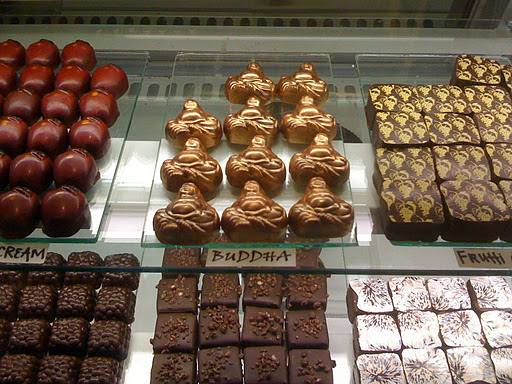
I spotted this confection at the Chicago French Market.

I assume that this pâtissier only intended that a chocolate Buddha confection would sell well; I doubt any deliberate offense to Buddhists. Even so, this is perhaps too fine an example of Buddhism consumerized and ingested as such. Not quite the traditional Dharma Burger, but I would still put it in the same category.

The Pew Study Marginalizes Asian Americans

At the heart of my exhortations that Buddhists should ignore the Pew Forum’s U.S. Religious Landscape Survey is that the study tragically misrepresents Asian America. Past critiques, such as those cited by Rev. Danny Fisher, focus on the Pew study’s methodological problems of potentially undercounting immigrants or omitting the state of Hawai‘i.

Fair points, but the impact of these methodological errors is hard to gauge. In other words, we can rail against the study’s methodological flaws until we’re red in the face, but in order to demonstrate (rather than speculate) that the outcome of the study is flawed, we have to look at the numbers. I’ve done this before, but given James Coleman’s ingenuous reading of the study, I feel obliged to do so again.

This exercise uses the estimated population of the United States during the year the Pew study was conducted—301.6 million (courtesy of the U.S. Census Bureau)—in addition to three statistics from the Pew Study: 0.7%of Americans identify as Buddhist, 32% of American Buddhists identify as Asian, and 9% of Asian Americans identify as Buddhist.

Apply the first percentage to the total American population in 2007, and you end up with some 2.1 million Buddhists in America.

Now if 32% of those American Buddhists are Asian, then there are a mere 676,000 Asian American Buddhists.

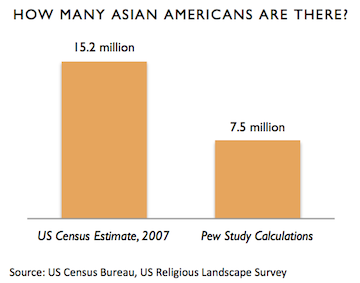
The Pew study tells us that 9% percent of Asian Americans identify as Buddhist, and since we know the Pew estimates there are about 676,000 Asian American Buddhists, we can combine these two statistics to reveal the size of Asian America in the eyes of the Pew study. It’s simple algebra: if 9% of x equals 676,000 then you just need to divide 676,000 by 9% in order to find x (i.e. the number of Asian Americans). This yields 7.5 million Asian Americans, or about 2.5% of the American population.

But wait a moment! The U.S. Census estimates there were 15.2 millionAsian Americans in that year. That’s more than twice the estimate we came to from the Pew study’s numbers.

Slice the numbers another way, and you arrive at the same dilemma. When Coleman writes about a very white liberal middle-class face of Buddhism, he bases his entire understanding on a set of numbers that are irredeemably skewed against Asian Americans. Take the Pew study’s Buddhism statistics at face value, as James Coleman does, and you partake in the racial marginalization of Asians in Western Buddhism.

I just can’t say it enough. Stop using the Pew study!

Why Shouldn’t Buddhists Use the Pew Study?

The Face of Western Buddhism” (Buddhadharma Fall 2011) is a perfect case study of how to marginalize Asian American Buddhists in print. Sociologist James Coleman depicts Buddhist America using the effectively racist dichotomy of immigrants versus converts and he whitewashes American Buddhist history by ignoring several decades of Asian American Buddhist pioneers. Most problematic is that the author presents his case as one based on sound empiricism.

Coleman paints the picture of an affluent White Buddhist America where “roughly three-quarters of American Buddhists are converts,” where “Buddhists are more likely to identify themselves as liberals,” where Buddhists “are more likely to have a higher income and better education than the average American” and where “Buddhists are the fastest-growing religious group in American today.”

The meat of this analysis comes from the U.S. Religious Landscape Surveyby the Pew Forum on Religion and Public Life—a study that no self-respecting academic could use to describe American Buddhism without being guilty of racial marginalization. As I demonstrated before, the Pew forum can only come to this sort of conclusion because its survey is skewed toward White middle-class Americans.

The Pew study itself even admits that the survey deserves “caution” when looking at religious groups with large numbers of immigrants:

English-only surveys, and even English surveys with a Spanish option, are likely biased in that their samples do not sufficiently represent the full spectrum of Latinos, many of whom are recent immigrants and are unable to complete a telephone survey in English. […] This suggests that caution is also in order when estimating the number of adherents of other religious groups that are disproportionately composed of immigrants, such as Hindus, Muslims, Buddhists and members of other world religions.

According to U.S. Census surveys, there were 14.9 million Asian Americans in 2007. If you follow the Pew study’s numbers, there were only 7.5 million. (You can do the math.) That’s a big difference and ample grounds to question any of the study’s findings on Buddhist America.

Honestly, people. Stop using the Pew study.

Taste of Chicago Buddhism

When I began blogging about Buddhism on Dharma Folk, there weren’t many Asian American Buddhists in the blogosphere. Now it seems as though every month I’m encountering a new blog written by an Asian American Buddhist. Taste of Chicago Buddhism is one such blog, written by Rev. Patti Nakai of the Buddhist Temple of Chicago.

The blog discusses topical issues on everything from Buddhism to Rev. Nakai’s community in ways that make me ever so slightly nostalgic for the Windy City. I particularly enjoyed her recent opinions on what students read about Buddhism. Her blog also paints another picture of “Chicago Buddhism” that’s quite a bit different from Stephen Asma’s red meat and whiskey version.

I hope you’ll have the chance to check out Taste of Chicago Buddhism and even enjoy it enough to add it to your blog list.