What Do You Know About the Pure Land?

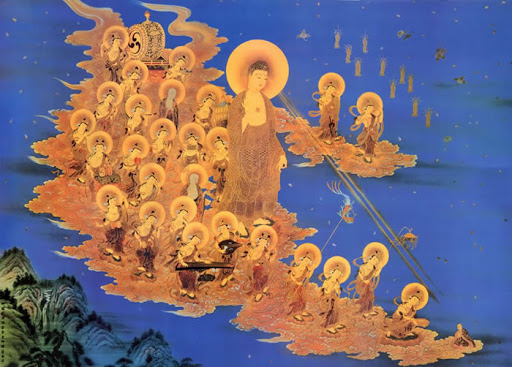
I am not a Pure Land Buddhist. My familiarity with Pure Land Buddhist traditions is rather limited, but I know enough to know that Douglas Todd’s Vancouver Sun article on Buddhism in Canada (“As Buddhism grows, two ‘solitudes’ emerge”) distorts the tradition to the point of stereotype. Todd depicts Pure Land Buddhism in Vancouver as a bunch of Asian Buddhist immigrants who don’t speak English and whose superstition-dominated spirituality consists of liturgical appeals to be reborn in a Buddhist heaven.

Pure Land is one tradition among many within Mahayana Buddhism, such that most of Vancouver’s Chinese Buddhist temples practice Pure Land Buddhism alongside sutra study, meditation, community service and non-Pure Land recitation practice. It is a cavalier misrepresentation of these temples’ Buddhist traditions for Todd to reduce all they do to the pursuit of a heavenly rebirth. Even Jodo Shinshu Buddhists, who focus more exclusively on Pure Land philosophy, aren’t just sitting around praying to be saved.

Take a look, for example, at Dharma Realm Buddhist Association, the organization of Ven. Heng Jung, who was the only Asian Buddhist whom Todd quoted. It’s more than just Pure Land. You will find Pure Land Buddhism practiced alongside scholarship, meditation, recitation and much more. Online, you can read the Dharma Forest blog and watch videosof Ven. Heng Sure, where you will find quite a bit more than repetitions of “Amitabha.” You could also check out the dharmas blog of Dharma Realm Buddhist University, where the vast majority of posts appear to be on subjects unrelated to the Pure Land.

Other Buddhist groups dominant in the Chinese Canadian community, such as Fo Guang Shan—the same organization that founded Rev. Danny Fisher’s employer—proudly promote both Pure Land and Ch’an meditation practice. There is even a diversity of views within these communities as to what the “Pure Land” means. “Many Pure Land practitioners today tend to stay clear of ‘the Pure Land exists’ idea and settle for Pure Land being in one’s own mind,” Ven. Zhi Sheng, a white Pure Land Buddhist, writes. “Pure Land practice is not just about being re-born in a lotus bud in the Land of Ultimate Bliss to live happily ever after. One will have missed the point completely.”

Most sadly, Todd missed out completely on Vancouver’s Jodo Shinshu community, one of the oldest in North America. If Todd had cared to sift through Tricycle and Buddhadharma online, he would have found Revs. Tai and Mark UnnoRev. Patti Usuki and Rev. Jeff Wilson talk about some of the very misconceptions of this Pure Land Buddhist tradition, which apparently were too enticing to avoid. There are quite a few other Jodo Shinshu perspectives online, such as Rev. Patti Nakai’s Taste of Chicago Buddhism blog or Rev. Harry Bridge and Dr. Scott Mitchell’s entertaining and illuminating Dharma Realm podcast, where they wrestle with questions from “What is Shin Buddhist practice?” to “Is Shin Buddhism in America really declining?

Note that none of the individuals mentioned here who follow Pure Land Buddhism are Asian Buddhist immigrants who don’t speak English—many are, in fact, Western converts.

While I have no doubt that there are Buddhists in Vancouver who will readily identify as Pure Land Buddhists and others who avow a yearning for rebirth in the Pure Land, for at least as many the Pure Land tradition is just one in a knapsack of Mahayana Buddhist traditions that an individual may practice. The Pure Land “practice” itself varies, just as practitioners have different perspectives on what the “Pure Land” actually is. You can learn more about Pure Land Buddhism by following the links above—I am by far no authority on this subject—however, from Todd’s article in the Vancouver Sun, you will find a stereotypical perspective of the type that Pure Land detractors would promote.
On the Newtown Shootings

I was glad to see that Tricycle pulled together a collection of responses by Buddhist teachers to the Newtown tragedy, but I was disappointed to see that not a single one of those teachers was Asian. Not only are the vast majority of Buddhist Amerians also Asian American, American temples with monks, nuns or priests of Asian heritage also play a role in communities with parents and children. There were invariably conversations within these communities where Asian American Buddhists discussed what all this meant and how to deal with this tragedy from a Buddhist context. But those perspectives will never be shared with us through the pages of TricycleShambhala Sun or Buddhadharmamagazines. If you’re curious to know what Asian American Buddhist teachers have said, you could visit the Taste of Chicago Buddhism blog for at least one perspective.

Update: Another relevant article to read is Ven. Losang Tendrol’s essay on the shootings in the Washington Post online.

Stereotypes of Asian Buddhists in Canada

I knew the article was going to be bad when I saw the first word misspelled: A-mi-tha-ba. Google could have helped on that one.

This careless misrendering of an Asian name of the Pure Land Buddha is but one of the myriad problems in Douglas Todd’s Vancouver Sun piece on Canadian Buddhism (“As Buddhism grows, two ‘solitudes’ emerge”). Todd attempts to stuff Metro Vancouver’s Buddhist diversity into a Two Buddhisms framework, and in so doing he misrepresents both Asian Buddhists and Pure Land Buddhist traditions by perpetuating common racist stereotypes and sectarian aspersions.

Todd’s Two Buddhisms are dubbed “ethnic Buddhism” and “Westernized Buddhism,” and he describes each group by their usual stereotypes. Ethnic Buddhism, for example, is “practised mostly by Asian immigrants, most of whom cannot speak English.” This assertion is incredible. According to the Canadian Census, the vast majority of Asians in British Columbia speak English, so why does Todd propose that Asian Buddhists are so much more unlikely to speak English than their non-Buddhist counterparts?

Of course, these überforeign ethnic Buddhists “generally meet in large extravagant-looking temples throughout the city.” Another cavalier assertion that can be inspected a little more closely. I went to British Columbia’s listing on the BuddhaNet World Buddhist Directory and ran Google Street View on the addresses of “ethnic” temples listed in Metro Vancouver. Mostly residential and office buildings turned up. I have a hunch that most Asian Buddhist congregants in Vancouver regularly attend services in buildings on the same order of “ordinary-looking” as the Gold Buddha Monastery that Todd described visiting.

Let’s not forget the claim that “‘ethnic Buddhists’ have a more supernatural bent.” I can’t imagine how many Asian Buddhists Todd must have interviewed to find that out, but as I demonstrated previously based on Pew Forum research, non-Asian Buddhists are more likely to believe in Nirvana than Asian Buddhists are. (The Pew Forum surveyed the United States, but Todd has separately stated that his “experience covering diversity issues suggests its findings can be comfortably extrapolated to Canada and Metro Vancouver.”) So perhaps Asian Buddhists are more likely than non-Asian Buddhists to believe in the supernatural, while being less likely to believe in Nirvana. I find that hard to believe, especially when Todd has no surveys to back him up.

Last, but not least offensive, is Todd’s depiction of Pure Land Buddhism in Vancouver as basically a bunch of Asians praying to get to Buddha heaven. The forms of Mahayana Buddhism practiced in Vancouver involve much more than just Pure Land practice. They even include meditation—just like those white Buddhists! Even congregations which identify primarily as Pure Land, such as the Jodo Shinshu Buddhist Temples of Canada, would probably surprise Todd with their approach to Pure Land philosophy. That’s worth a whole post on its own.

If by chance Todd cares to amend any of the numerous errors in his article, it may be best to start with a spell check. For example, the largest Buddhist school is called Mahayana—not Mayahana. Wow. My iPad’s autocorrect just tried to fix that one.

Best Buddhist Writing Back to Normal

If last year’s edition of The Best Buddhist Writing was the most Asian volume published to date, then this year’s volume is a return to normal.

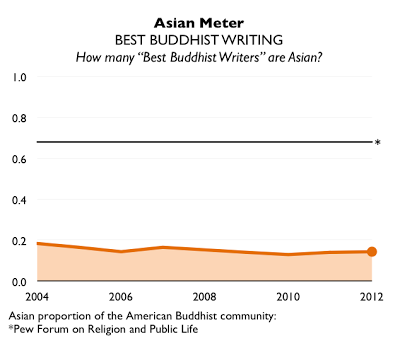
For the past nine years, Melvin McLeod and the other Shambhala Sun editors have gathered into a single book “a thought-provoking mix of the most notable and insightful Buddhism-inspired writing published in the last year.” On average, six or seven Asian writers make it into the volume, which translates to a ratio of about one in five. This year is perfectly typical with six Asian writers at a ratio of exactly one in five. That’s not many when you consider that more than three-in-five American Buddhists are Asian.

I had hoped that last year’s exceptional number of Asian writers would mark the start of a new normal. Compared to The Big Three print magazines, The Best Buddhist Writing historically includes a higher proportion of Asian authors. The editors even highlighted their awareness of diversity issues last year when they organized a Buddhadharma forum titled, “Why is American Buddhism so White?” Maybe there wasn’t much good Asian writing to be found this year. Maybe 2011 was a fluke.

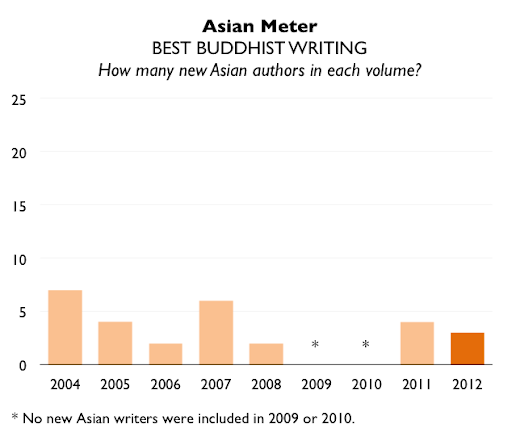
The editors at least managed to find new Asian writers, unlike the two years when the only Asian authors included where those who had been published in previous volumes.

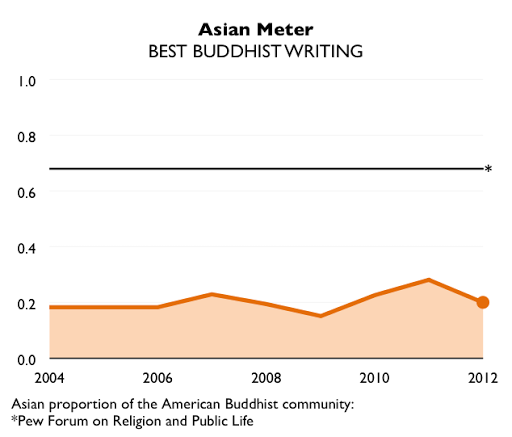
If Asian Buddhist writers are to be better represented in The Best Buddhist Writing, then the yearly number of new Asian authors will have to grow. This shift will be reflected in the measure of “Best Asian Writers”—those who have ever been published in The Best Buddhist Writing—as a proportion of the total lot of “Best Buddhist Writers.” Since the series’ inception in 2004, this proportion has declined from less than one in five to now just one in seven.

In other words, new non-Asian writers have been included in The Best Buddhist Writing at a greater frequency than Asians have been.

For The Best Buddhist Writing to meaningfully include more Asian writers, the editors could include in each volume the writing of four Asians who had not been included in any previous edition. That’s just one more than the three new writers who are currently added on average each year. Of course it means that more work would need to be done to find that worthy piece of writing. My hunch is that as the Shambhala Sun editors get more used to seeking out good writing by Asian authors, they will develop sharper intuitions on where to look and they’ll find some more promising work along the way.

We’ll see how The Best Buddhist Writing turns out next year. In the meantime, I hope you enjoy The Best Buddhist Writing 2012.