Don’t Forget Vincent Chin

My earliest experiences of Asian American political activism were dinner table discussions of the Vincent Chin case. I have mentioned his name repeatedly over the years, as his murder reflects many of the dilemmas with which Asian Americans continue to struggle. Vincent Chin died 30 years ago today. His last words were, “It’s not fair.”
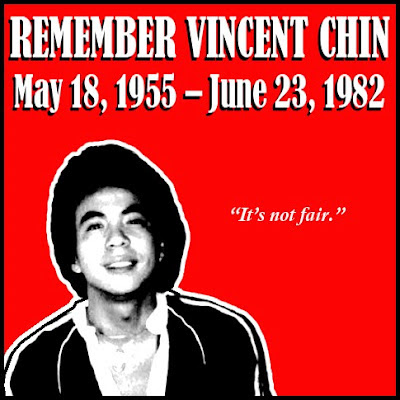
If you’ve never heard of Vincent Chin, or if you wonder why this case is of any importance, I encourage you to read the New York Times Op-Ed “Why Vincent Chin Matters” by Frank H. Wu.

On June 23, 1982, in Detroit, a young man named Vincent Chin died. Four nights earlier, he had been enjoying his bachelor party with friends at a local bar when they were accosted by two white men, who blamed them for the success of Japan’s auto industry. “It’s because of you we’re out of work,” they were said to have shouted, adding a word that can’t be printed here. The men bludgeoned Mr. Chin, 27, with a baseball bat until his head cracked open.

The men — a Chrysler plant supervisor named Ronald Ebens and his stepson, Michael Nitz — never denied the acts, but they insisted that the matter was simply a bar brawl that had ended badly for one of the parties. In an agreement with prosecutors, they pleaded to manslaughter (down from second-degree murder) and were sentenced to three years of probation and fined $3,000.

It has been a long time since Vincent Chin. His murderer lives a quiet life in Nevada, never having served a day in jail. I would like to think that the days of hate crimes against Asians are long behind us, but that was what I was thinking when Thien Minh Ly, an aspiring diplomat and devout Buddhist was murdered in Southern California. Just two days ago I read about a Vietnamese man in Oregon who’s had bombs thrown at his house. It’s not fair.

To learn more about the Vincent Chin case and it’s importance with regard to modern Asian American political activism, check out the film Vincent Who?, produced by a family friend. You can view the trailer below.

And please don’t forget Vincent Chin.
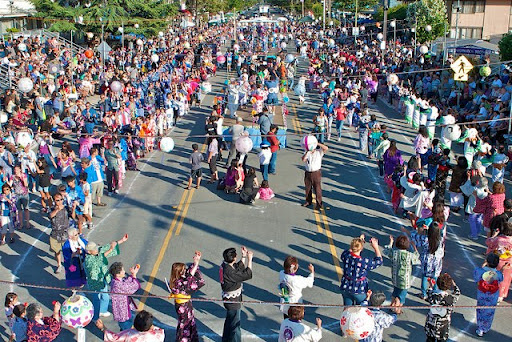
It’s Obon Season!

Temples across North America are starting their Obon practices this month, so now’s the time to go break out your kachi kachi and start to plan out a summer full of Obon hopping!

There are Obon festivals and bazaars all across North America in the coming months. You can keep track of them at Japanese City’s 2012 Japanese Obon & Bon Odori Schedule.

I’m not going to list out the dates as I did in previous years, in part because I’m so lazy, but mostly because Japanese City does such a better job. They even have a map and list of the most popular festivals. Seriously: 樂威壯 .japanese-city.com/calendar/events/index.php?com=location”>check out the map!

If you’re in Hawai‘i, you can stay on top of the local schedules at the Dancing Fools Bon Dance Posse Facebook page.

And perhaps you are wondering: “What is Obon?

See you in the dance circle!

(Photo credit.)

Buddhism in the American Mainstream

Perhaps it’s all a bad gamble that there might be stories out there, somewhere, of Buddhism in the American mainstream unpreoccupied with neophytic meditators or scholarly navel gazers. While I often write as though the secret is hidden behind some language barrier or waiting for a generation of storytellers to come of age, the more likely case is that these “untold stories” are actually hiding in plain sight. One such story is Barbara Chai’s journey to interview the Dalai Lama.

[Archivist note: regrettably, the rest of this post and one comment were lost in the transition to the new server.]

OMG Western Buddhists!

“Western Buddhism” is in the mainstream news again. The Gray Lady shares some Buddhisty thoughts of one newcomer to meditation, while you can read more blather about “American Buddhism” at the Washington Post’s On Faith blog. How completely novel that yet another white American Buddhist would make bland speculations about the future of Buddhism in the West!

As someone who occasionally contributes a blog (or two) about Buddhism in the West, I just wish American newspapers wasted less ink yogifyingWestern Buddhism with boring reflections of meditation retreats (“Dude, I went on a meditation retreat… woah…”) or culturally appropriative fantasies on the future of the Western Buddhist community (“WESTERN BUDDHISM IS GOING TO BE SO GREAT! I CAN’T WAIT!”). Now the authors were not so inane as my parenthetical hyperbole would suggest, but there are much more interesting perspectives on Buddhism in the West than neophytic meditators or scholarly navel gazers.

Not that there’s much I’m prepared to do about it right now. Fortunately, there is a whole generation of young American Buddhists, raised in temples and Dharma centers, who are gradually coming of age and, I hope, preparing to share the story of a mainstream American Buddhism which you’re quite unlikely to find in the pages of mainstream East Coast periodicals.